Skip to content
AFX Research logo

Know What You Are Looking At

Types of Property Easements

Easements divide first by who benefits, and then by what the holder is allowed to do. Here are the eight that come up most often, and an honest note about which ones a search of the land records can actually find.

Two questions sort every easement

The first question is who benefits. If the benefit belongs to a neighboring parcel, the easement is appurtenant and it travels with the land when either parcel is sold. If the benefit belongs to a person or a company instead, it is an easement in gross, which is the form utility easements take.

The second question is what the holder may do: run a power line, drain stormwater, cross the property to reach a road, or leave the land undeveloped. That is what the categories further down describe.

Both questions are answered by the instrument that created the easement. That instrument is what an easement search retrieves, so you can read the grant rather than infer it.

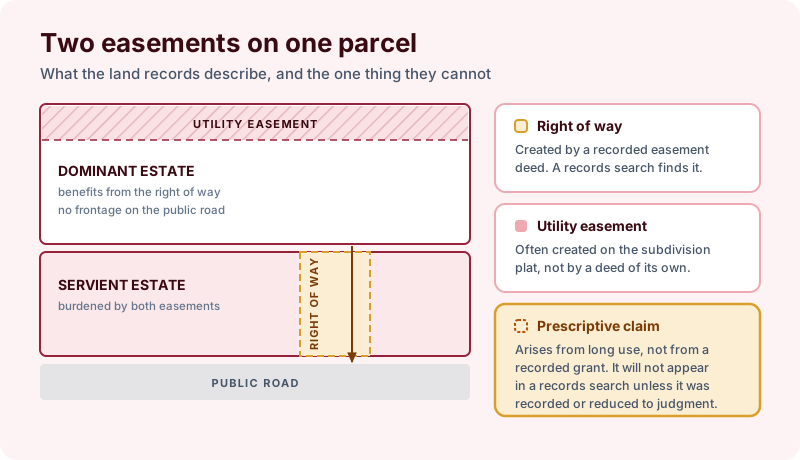
Plat-style diagram: a rear dominant estate with a hatched utility easement along its rear boundary and no road frontage, a front servient estate crossed by a gold right-of-way strip running down to the public road, and a note that a prescriptive claim arises from long use and will not appear in a records search unless it was recorded.

Found in the Land Records

Easements created by a recorded instrument

These are created by a document that gets recorded against the parcel. An easement search reports the ones found of record for the term you select, with the instrument attached.

Usually recorded

Easement Appurtenant

An easement appurtenant benefits one parcel, the dominant estate, and burdens another, the servient estate. It attaches to the land rather than to a person, so it ordinarily passes to the next owner of each parcel when either one is sold.

This is the type most people mean when they say a property "has an easement." A classic example is a driveway easement letting one lot reach a public road across its neighbor. Because it runs with the land, buying the burdened parcel usually means buying the burden with it.

Usually recorded

Easement in Gross

An easement in gross is a right held by a person or a company rather than by a neighboring parcel. There is a burdened property but no benefited one, which is why utility easements take this form.

A power company holding the right to run and maintain lines across a lot holds an easement in gross. Commercial easements in gross are generally transferable, so the holder named in a decades-old instrument may not be the company that services the line today.

Usually recorded

Utility Easement

A utility easement gives a provider the right to install, access, and maintain electric, gas, water, sewer, or telecommunications infrastructure across private property.

Utility easements are the most common encumbrance we report. They matter because they constrain what can be built where: an addition, pool, or detached garage placed over a utility easement may have to come out at the owner’s expense if the provider needs access.

Usually recorded

Right-of-Way Easement

A right-of-way grants passage across a parcel. It can serve a neighbor, a utility, or the public, and it is the easement most likely to be load-bearing for whether a parcel is usable at all.

For a landlocked parcel, the right of way is the property’s access to a public road. Buyers sometimes assume a driveway in daily use is documented; whether an instrument exists, and what width and use it actually permits, is a question the record can answer.

Usually recorded

Drainage Easement

A drainage easement reserves part of a parcel for the flow or retention of stormwater, often in favor of a municipality or a homeowners association.

These are frequently created on the subdivision plat rather than by a separate deed, which is one reason a search that reaches back to the original platting can surface burdens a shorter search would not.

Usually recorded

Conservation Easement

A conservation easement permanently limits development or use to protect farmland, habitat, water, or a historic structure, and is typically held by a land trust or a government body.

Conservation easements are usually perpetual and are recorded, so they show in a title search. Because they cap what can ever be built, they can affect both value and financing well beyond the term of any single owner.

Where a Records Search Stops

Easements that may never have been recorded

Some easements are created by conduct or by operation of law rather than by a written grant. If nothing was recorded, no search of the land records will show them. We would rather say that plainly than let a clean report be read as proof that a parcel is unburdened.

Often unrecorded

Prescriptive Easement

A prescriptive easement can arise from long, open, continuous use without the owner’s permission. The requirements and the time period are set by state law and vary considerably.

This is the important limit of any records search. A prescriptive claim is created by conduct rather than by a recorded grant, so unless it has been reduced to a judgment or an instrument that was recorded, no search of the land records will show it. A survey and an inspection of what is actually happening on the ground are the tools for that question.

Often unrecorded

Easement by Necessity

An easement by necessity can be implied when a parcel is split in a way that leaves one piece without access to a public road. It is a creature of law rather than of a written grant.

Because it is implied, it may exist without any instrument in the record. What a search can do is show the deeds that split the parent parcel, which is the history a court or an attorney would work from.

What to pair with a records search

A boundary survey shows where things physically sit and what is actually being used on the ground. A records search shows what was written down and recorded. They answer different questions, and on a parcel with a suspected unrecorded claim you want both. Whether a particular claim would succeed is a legal question for an attorney licensed in that state, not a conclusion an abstractor draws.

Next Step

Find out which of these are on your parcel

A certified abstractor searches the county land records against the address you give us and reports the easements found of record over a 20, 30, or 50 year term, with a copy of each recorded instrument attached.

Not sure which term fits? Call 877-848-5337 ext. 138 with the address and we will tell you.

Order Your Easement Search Today

Certified abstractors search the county land records against your parcel and report the easements found of record, with a copy of every recorded instrument attached. Order online in minutes, or tell us about the parcel and we will help you pick the search term.

Questions? Call 877-848-5337 ext. 138 or email info@afxllc.com